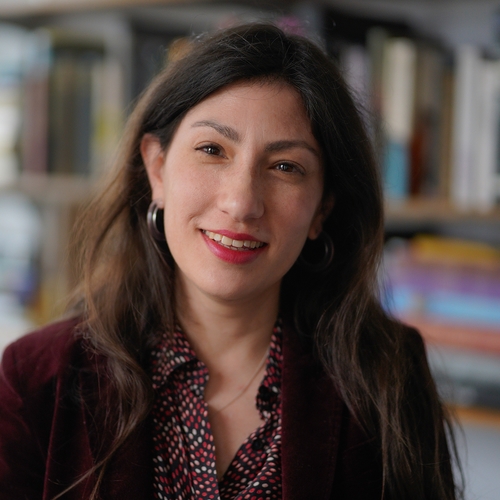
Emily Ruth Capper
271 19th Ave S
Minneapolis,
MN
55455
I am Assistant Professor in the Department of Art History, and Affiliate Faculty in the Department of Cultural Studies and Comparative Literature, the Programs in Comparative Literature and Comparative Studies in Discourse and Society, and the Program in Moving Image, Media, and Sound. My research explores modern and contemporary installation, performance, and media art in ways that forge linkages with overlooked intellectual, social, and institutional histories.
My first book, Happening Pedagogy: Allan Kaprow’s Experiments in Instruction, is forthcoming from the University of Chicago Press. I argue that Allan Kaprow’s famed invention of the happening brought together experimental traditions of modernist pedagogy with emerging forms of American undergraduate student culture—from hazing rituals to campus protests. I trace Kaprow’s trajectory from 1948 to 1968, following him through the classrooms of three of his professors who were prominent figures in postwar American art—painter Hans Hofmann, art historian Meyer Schapiro, and composer John Cage—and across institutions including Rutgers, Stony Brook, Cornell, CalArts, and UC San Diego. Although Kaprow’s teachers were educated in the distinct disciplines of studio art, art history, and music, all three designed their classrooms to cultivate student creativity and critical reflection through forms of social exchange. Happening Pedagogy shows that Kaprow transformed these modernist classrooms into new pedagogical environments that worked within the novel context of the suburban state university. Drawing on archival sources, the book describes how Kaprow engaged the culture and creative work of middle-class college students, whose rituals he took seriously as a vernacular avant-garde. In this way, Kaprow’s happenings represent a critical extension of modernism as a social practice of sensory attunement, experimentation, and philosophical critique. Through Kaprow’s work, modernist pedagogy became an artistic medium in itself, and his participation-based creative practices helped define the broad resurgence of the American neo-avant-garde after 1960.
Educational Background
- Ph.D.: Art History and Cinema and Media Studies, University of Chicago, 2016
Specialties
- Modern and contemporary art
- Critical theory
- The social history of art
- Intellectual history
- Film and media studies
- Performance art