Resources
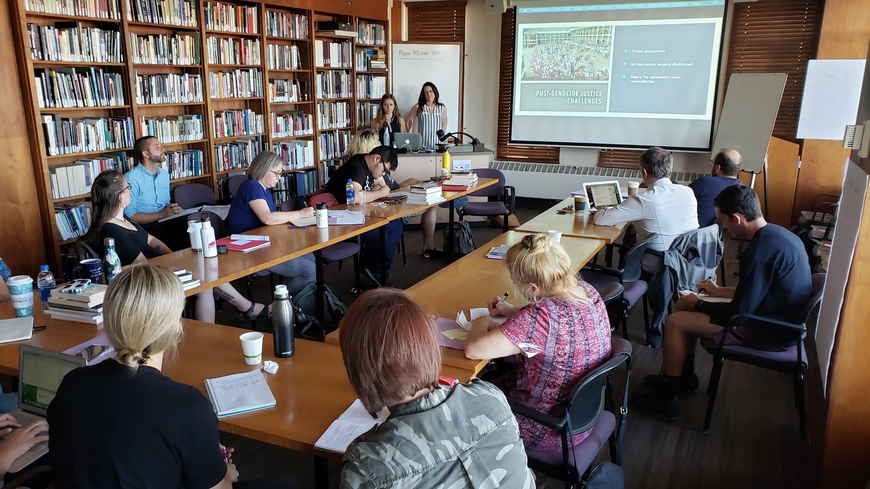
The Center for Holocaust & Genocide Studies offers a variety of resources related to the Holocaust and other genocides. They have been developed as a collaborative effort between faculty & staff at the University, practicing educators, and our community partners across the region.
Resource Guides
CHGS resource guides contextualize for educational purposes specific cases of genocide and incidents of mass violence. They are written by expert PhD candidates and scholars from various fields. Each provides a basic overview and includes events that led up to the violence, local and international responses, information on key actors, important terminology, and other relevant source materials. Also included are links to other authoritative sources and materials, including those from the University of Minnesota collections.
- Armenia
- Cambodia
- Daesh/Islamic State
- Denial
- Holocaust
- Holodomor
- Rwanda
- Teaching the Holocaust through Art
- U.S.-Dakota War
Story Maps
The Center has created a number of engaging virtual exhibitions that probe deeper stories related to the Holocaust and genocide.
- Al Tocar Diana: Martin Maki and the Lincoln Brigade in the Spanish Civil War
- From the Sioux Massacres to the Dakota Genocide
- Minnesota Shoah Stories
- Misshapen Archives: Maxine Rude's Displaced Persons Camp Photographs
Lesson Plans & Activities
The Center has collected a growing number of lesson plans from graduate students and teachers related to genocide. If you wish to submit your own lesson plan, contact us at [email protected].
-
The 1994 Genocide Against the Tutsi in Rwanda IDM: Is Reconciliation Possible after Genocide? (Google Doc version)
- Art and Genocide IDM: What can art communicate about the aftermath of genocide that words sometimes fail to express? (Google Doc version)
- The Francoist Regime IDM: How did the Francoist Regime transform Spain’s society and politics? (Google Doc version)
-
The Spanish Civil War and the International Brigades IDM: How did Black Americans see the Spanish Civil War (1936–1939) as part of their struggle against racial injustice in the United States? (Google Doc version)
- Transitional Justice IDM: How can societies move forward after genocide and systematic injustice, and what mechanisms make that possible? (Google Doc version)
- The US Dakota War curriculum (Google Doc version)
Model Lesson Plans from the Minnesota Department of Education
These lesson plans were developed by the Holocaust, Genocide of Indigenous Peoples and Other Genocides working group at the Minnesota Department of Education.
- The Holocaust (8th Grade): What happens when fear and antisemitism become part of a society’s law and
institutions? - The Holocaust (High School World History): Why does the international community often fail to act in the face of injustice?
- Black Genocide (7th Grade US History): Exploring how Black families’ and organizations’ fight for justice and cultural survival
redefined freedom and community - Black Genocide (High School US History): Exploring how freedom was contested during the American Revolution
The Center’s Collections and Exhibitions
The Center facilitates access to primary sources that focus on genocide survivors, liberators, and witnesses living in Minnesota. The CHGS digital archive includes artwork, photographs, testimonies, and other artifacts from around the world. Our YouTube channel features recordings of past programs and events. In partnership with UMN Libraries, CHGS also promotes usage of the USC Shoah Foundation’s Visual History Archive, a massive collection of 55,000 testimonies given by genocide survivors.