Why Minnesota?
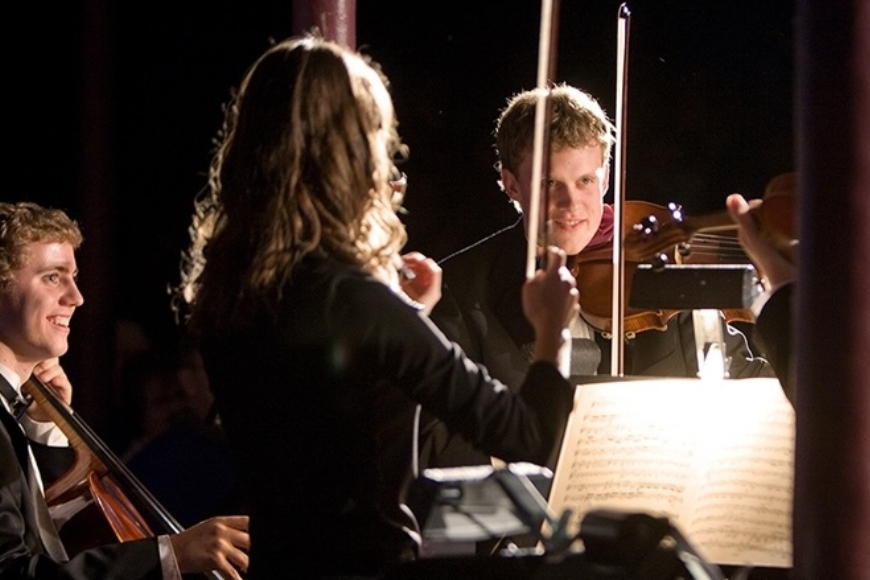
Study music in a small and welcoming school, where you will build strong and lasting friendships with other passionate musicians and work closely with dedicated faculty who are invested in your education and success. In our hands-on classes and lessons, you will have access to the highest quality of professional training in music that will prepare you for a broad variety of careers, including performance, education, therapy, and more, all of which draw from our rich variety of specialty areas.
"The best part of my experience at the U of M so far has been the people. The faculty and staff members have gone out of their way to make all of the new students in the School of Music feel welcomed and prepared for the semester." —Alyssa, graduate student
Join our vibrant community of musicians on campus and in the Twin Cities as you come to understand, share, and disseminate music through creation, performance, research, and education. As you dive deeper into your education, you will learn the finest technique and come to better understand your own musicality as an artist and student. Our ensembles foster an open and inclusive sense of community among students, while our lessons allow for close work with our faculty.
Here in the School of Music, you will have the opportunity to enjoy the many advantages of a premier research University while also benefiting from the welcoming and friendly atmosphere created by our small cohort of faculty, students, and staff, gaining a truly world-class education.
Our Mission
The mission of the School of Music is to understand, share, and disseminate music through creation, performance, research, and education. We are committed to excellence in all scholarly, creative, and pedagogical endeavors. We seek to provide the highest quality of professional training in music to students pursuing a broad variety of careers and offer artistic, cultural, and intellectual enrichment to the community within and beyond the University of Minnesota.
History
The School of Music is proud to celebrate its rich history as it marks its 125th year of music education. Currently led by Director Patrick Warfield, the school is growing and transforming its offerings to match long-term trends in the music industry. A rich collection of collaborations within the university and between the major music and music education organizations of the greater Twin Cities provides an exciting environment for excellence in performance, teaching, and research.
The University of Minnesota has offered musical instruction since at least 1879, and in 1902 the Board of Regents authorized a Department of Music with the German-born conductor Emil Oberhoffer as its first chairperson. The following year, Oberhoffer led the first concert of the Minneapolis Symphony Orchestra, the ensemble that would later become the renowned Minnesota Orchestra. We are proud to have nurtured this important relationship into the twenty-first century.
As the music program grew, so too did its connections with the surrounding community. Carlyle Scott joined the faculty in 1904 and became chair in 1910. Under his leadership the department grew to nearly thirty faculty members, and the department’s first concerts were given in the East Bank’s Pillsbury Hall. The department moved into its first permanent home, named after Scott, in 1922. In 1927 the University opened Northrop Auditorium, which served as the department’s main performance space, became home to the Minneapolis Symphony, and hosted touring productions of the Metropolitan Opera. Under the leadership of Paul Oberg (chair, 1942–65), the program joined the National Association of Schools of Music (NASM) and hired several high profile faculty members.
By the 1970s, the Department of Music had outgrown Scott Hall, and indeed instruction was scattered across thirteen different buildings. Lloyd Ultan oversaw the construction of our current academic home on the West Bank, Ferguson Hall, and also our 1980 transformation from department into a School of Music. Our principal recital hall is now named for Ultan. Karen Wolff (dir., 1987–91) established the doctoral conducting programs, brought the Department of Music Education into the School of Music, and further deepened our ties to the community. Vern Sutton was appointed director in 1992 and the Ted Mann Concert Hall was dedicated the following year. The Ted Mann Concert Hall remains one of the finest acoustical spaces in the Twin Cities and regularly hosts performances by the Saint Paul Chamber Orchestra, VocalEssence, The Greater Twin Cities Youth Symphonies, and many other regional organizations. Our final space, the band suite in Huntington Bank Stadium was opened in 2009.
Special experiences over the years have made the School of Music a memorable home to study, made possible by the vibrant Twin Cities music community. In recent years, we've welcomed incredible guest artists to campus such as eighth blackbird, Anthony McGill, Third Coast Percussion, Cory Wong and Frederica (Flicka) von Stade. The Marching Band performed with Justin Timberlake at the 2018 Super Bowl Halftime Show, and with the Jonas Brothers on their 2019 tour. In 2025, the Chad Smith Foundation established the Curtis and Joan Smith scholarship, which included a special Homecoming performance by Chad Smith himself. Our students have been given the opportunity to perform alongside the Minnesota Orchestra and the St. Paul Chamber Orchestra, and the choral programs often perform in the historic Cathedral of St. Paul.