Coahuila
Located in the northeastern region of Mexico, Coahuila de Zaragoza, more commonly referred to as Coahuila, is one of the 32 states that makes up the United States of Mexico. This state is composed of 38 municipalities, with its capital being Saltillo. One of the largest and least densely populated states in the country, it shares borders with Texas to the north, Chihuahua to the west, Nuevo León to the East, and with Durango and Zacatecas to the South.

Disappearances in Coahuila
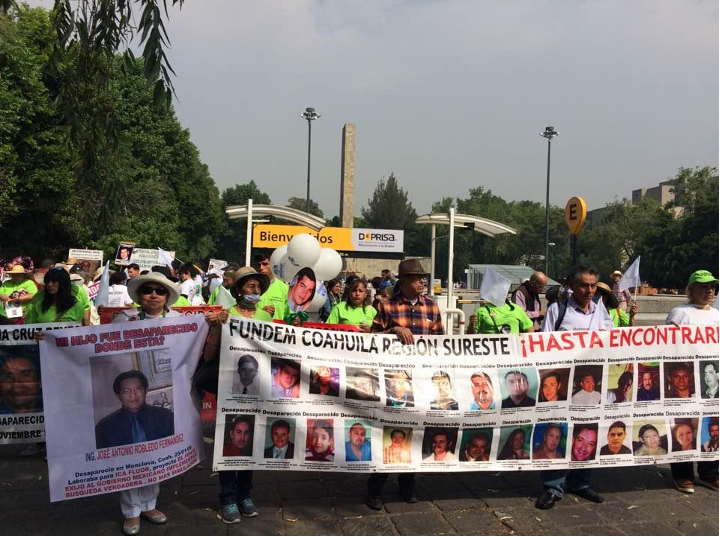
The increasing presence of violence in Coahuila led to the increase in the number of disappearances observed in this region. As of February 2020, the government reported that 3,328 individuals have been disappeared in the state. This figure includes both those individuals who remain disappeared as well as those who have been found.
The Observatory’s press database contains 196 press-reported disappearances between 2009 to mid-2018, with a high number occurring in 2009 and 2010 (90 victims, 46%).
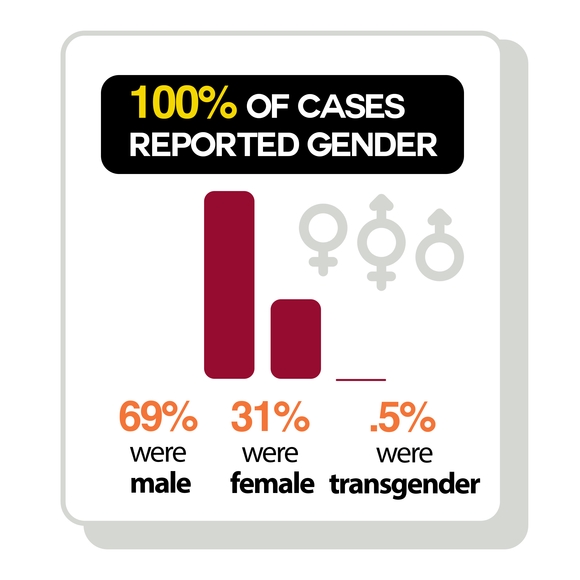
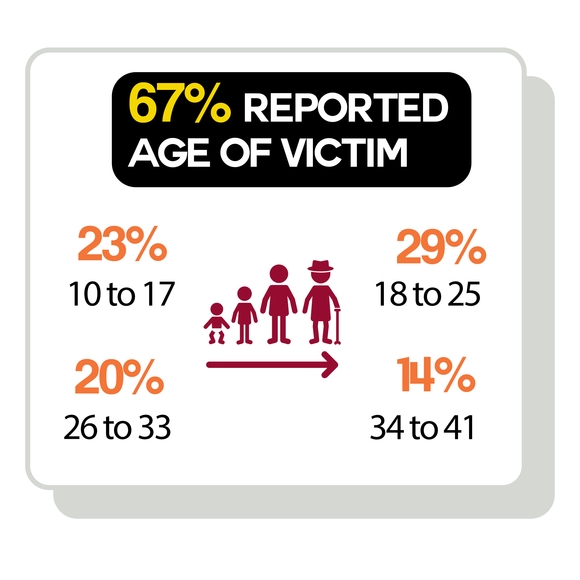
Those at highest risk of being disappeared are men in transit by foot or car-- many of whom are chauffeurs or entrepreneurs-- between the ages of 17 and 37, with the average age being 29 (Observatorio, 2019). The press database confirms these findings: according to the information collected on reports published by the press in Coahuila on disappearances, nearly 7 out of 10 (69%) of the victims of disappearances are reportedly male, the average age was 26.
| 100% of Cases Reported Gender | 67% Reported Age of Victim |
|---|---|
|
|
Infographic stats: 100% of cases reported gender; 69% were male; 31% were female; .5% were transgender. 67% reported age of victim; 23% 10 to 17; 29% 18 to 25; 20% 26 to 33; 14% 34 to 41.
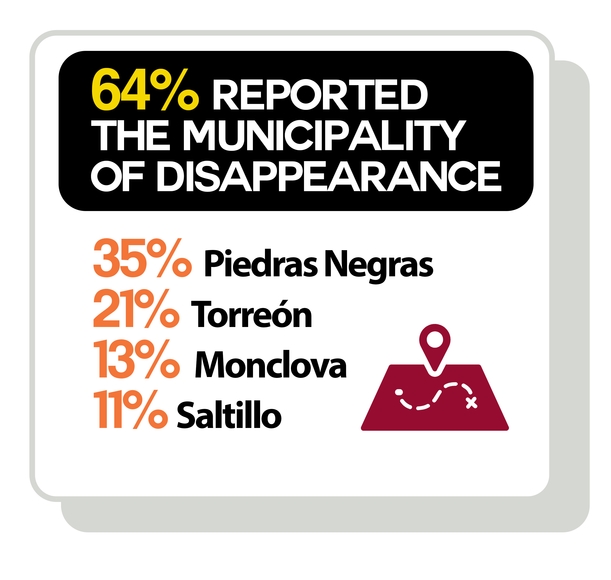
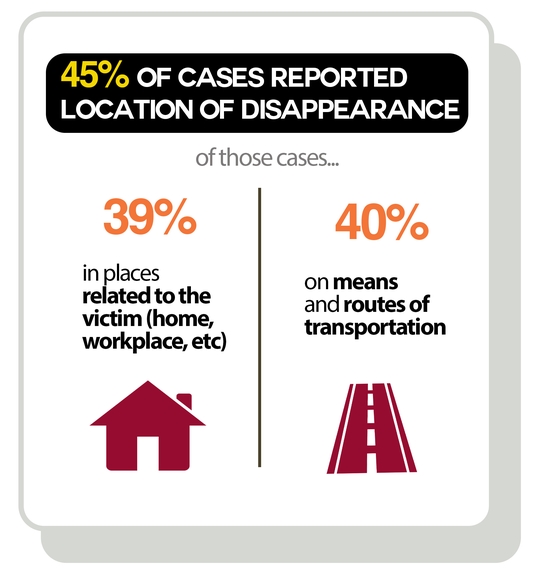
The data gathered from press reports by the Observatory found that --when the press reported a location of disappearance-- most victims disappeared from a place familiar to them or while in transit (80%). While disappearances have been registered in 18 of the 38 municipalities of Coahuila, those areas with the highest rates of disappearances are at the borders -- Torreón and Piedras Negras -- which have become zones of violence.
| 64% Reported the Municipality of Disappearance | 45% of Cases Reported Location of Disappearance |
|---|---|
|
|
Infographic stats: 64% reported the municipality of disappearance; 35% Piedras Negras; 21% Torreon; 13% Monclova; 11% Saltillo. 45% of cases reported location of disappearance; of those cases: 39% in places related to the victim (home, workplace, etc); 40% on means and routes of transportation.
Persons from marginalized groups, such as migrants, are at a relatively higher risk of being disappeared, especially given Coahuila’s long border with the United States. Piedras Negras is one of the primary points where northbound migrants may cross the Rio Grande into the United States. Despite this, we found that the press rarely reported on the nationalities or personal backgrounds of the victims in Coahuila.
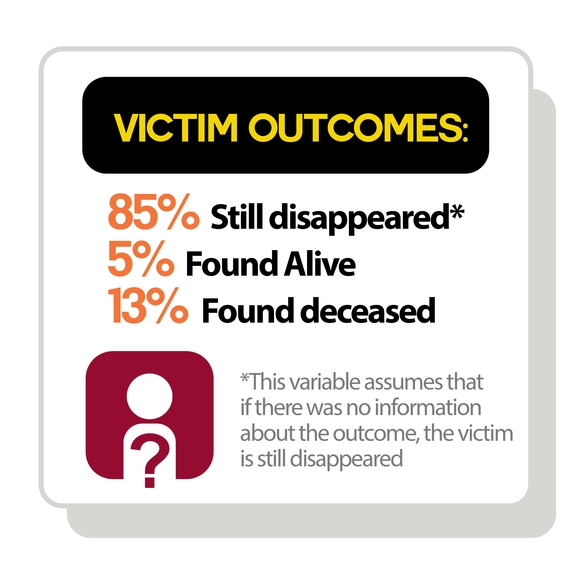
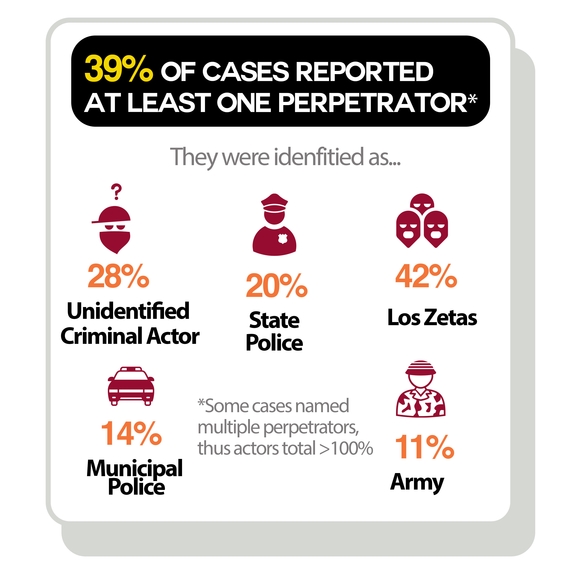
According to FLACSO, a vast majority - close to 80%- of disappeared individuals in Coahuila remain disappeared. It is rare for victims to be found dead or alive. The findings from the press database support this disheartening statistic: in only one of five cases in Coahuila did the press report an official search for the victim. In 85% of cases, the press reported the victim as still disappeared, or did not report an outcome. Both state officials and members of organized crime groups have been identified as the perpetrators of disappearances; many suspect that members of the military division, Grupo de Armas y Tácticas Especiales (GATE), have been responsible for disappearances and that, additionally, state and federal actors collaborated with Los Zetas in the orchestration of disappearances (Observatorio, 2019). The press database corroborates these findings; when a suspected perpetrator was identified by the press, Los Zetas were the most frequently reported (32 cases). Additionally, the press reported state actor involvement: state police (15 cases), municipal police (11 cases), and the army (10 cases).
| Victim Outcomes | 39% of Cases Reported at Least One Perpetrator |
|---|---|
|
|
Infographic stats: Victim Outcomes: 85% Still disappeared (assumes that if there was no information about the outcome, the victim is still disappeared); 5% Found alive; 13% Found deceased. 39% of cases reported at least one perpetrator; they were identified as 28% unidentified criminal actor; 20% State police; 42% Los Zetas; 14% Municipal police; 11% army.
In Coahuila, even in reported court cases, justice was elusive. In many cases, the legal system is portrayed by the press as functioning in a superficial manner, with charges dismissed against many suspected perpetrators, most notably if the alleged suspect had money and power. For example, in the case of the disappearance of Jose Antonio Robledo Fernandez (Toño), charges against Carlos Enrique Haro Villeral- a businessman linked to Toño’s employers- were dropped despite the presence of lethal weapons and folders containing information on the victim in his house. The judge declared that it was insufficient to bring charges against this businessman.
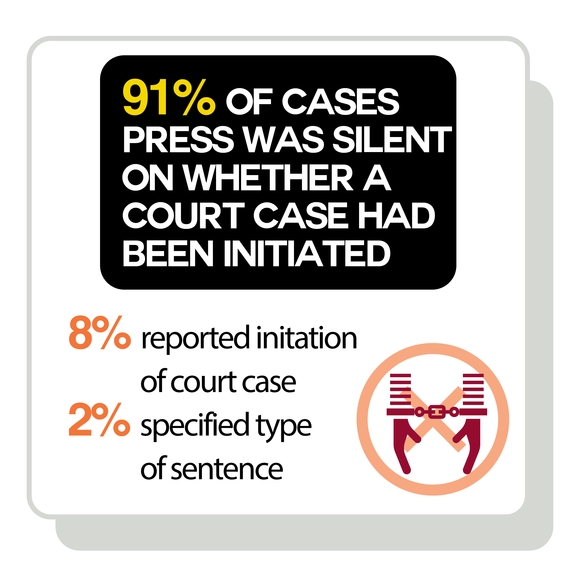
Cases reported as being seriously investigated by the authorities typically involved the disappearance of an important official, a group disappearance, corporate corruption, or a combination of the three. The case of Atzy Adamary Reina Saucedo, a mother of two who disappeared from Allende along with her husband and five other individuals, highlights the fact that group disappearances also tend to attract both legal and popular attention. In cases in which ordinary individuals were reported to have disappeared alone, the press almost never reported on subsequent legal investigations, suggesting the disappearance of justice as well, their case just another unexamined file in the seemingly bottomless file drawer of impunity in Coahuila.
| 91% of Cases Press was Silent on Whether a Court Case Had Been Initiated | 49% of Cases Reported Occupation of the Victim |
|---|---|
|
|
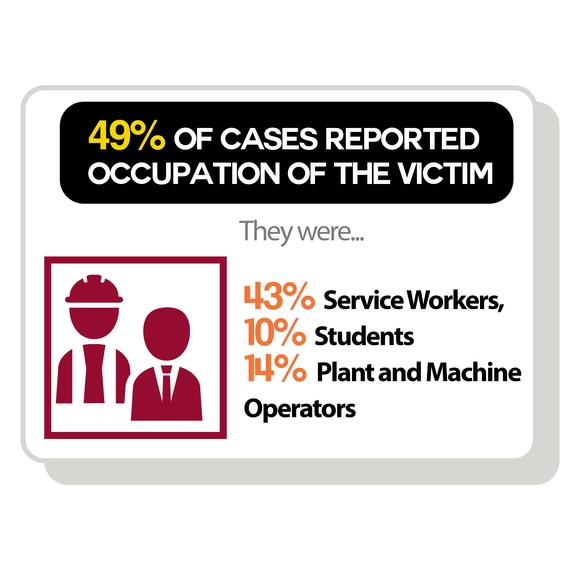
Infographic stats: 91% of cases press was silent on whether a court case had been initiated; 8% reported initiation of court case; 2% specified type of sentence. 49% of cases reported occupation of the victim; They were: 43% service workers; 10% students; 14% plant and machine operators.
Impunity
In Coahuila, even when the court cases resulted in convictions, justice was not guaranteed for the victims and their families. In many cases, the legal system was portrayed by the press as functioning in a superficial manner, with charges frequently dismissed against suspected perpetrators, especially if they had money and power. For example, in the case of the disappearance of Jose Antonio Robledo Fernandez (Toño), charges against Carlos Enrique Haro Villeral--the businessman that managed the security company contracted by Toño’s employers-- were dropped despite the presence of lethal weapons and folders containing information on the victim in his house. The judge, in spite of the incriminating evidence, claimed insufficient evidence to support charges against this businessman.
The cases reported as being seriously investigated by authorities typically involved the disappearance of an important official, a group disappearance, corporate corruption, or a combination of the three. The aforementioned case of Jose Antonio Robledo Fernandez illustrated the fact that corporate involvement in a disappearance tended to attract attention from both the press and judicial system. Group disappearances also attracted more attention. Atzy Adamary Reina Saucedo, a mother of two who disappeared from Allende along with her husband and five other individuals, received attention from the press and the criminal justice system. These kinds of cases were the exception. The thousands of everyday cases in which individuals disappeared by themselves usually went unreported, and if they did appear in the press, there was no apparent follow-up by the press or the courts.